The right cart can turn a scattered collection of cameras, monitors, batteries, media, and tools into a mobile production hub. For film crews, the best option depends on payload, terrain, storage layout, and how quickly the cart must move between setups.
We compare 10 utility carts for film production, from foldable models for lean crews to high-capacity studio carts built for demanding equipment loads.
Best 10 Utility Carts for Film Production Picks for 2026
Titanrig Workstation

- 440-lb capacity with three shelves
- Flat-free 9-inch swivel wheels
- Tool-free folding and rigging interfaces
Best For: Customizable mobile workstations for professional production teams
Vanguard UC5
Extendable All-Terrain Production Cart

- Eight configurations with a 32–53-inch bed
- 440-lb standard capacity
- Air-free wheels and folding handle
Best For: Outdoor locations and oversized or changing equipment loads
StrideoooTrek Heavy-Duty
660-Lb Three-Shelf Production Cart

- 660-lb maximum load capacity
- Three-tier steel workstation
- Locking all-terrain pneumatic wheels
Best For: Heavy studio and stage equipment transport
Bowado 36
Collapsible Three-Tier Camera Cart
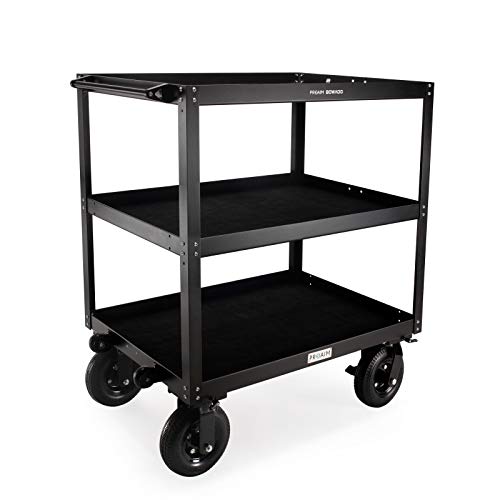
- 440-lb three-tier capacity
- 9-inch pneumatic wheels
- Carpet-lined shelves and collapsible design
Best For: Organized camera, sound, lighting, and grip transport
Heavy-Duty Studio Hauler

- 1,000-pound payload capacity
- Carries C-stands and grip gear
- Four 10-inch pneumatic wheels
Best For: Large studio and location productions with heavy equipment loads
Portable DIT Workstation
DIGITALFOTO Folding Camera Cart

- Folds for car-trunk transport
- Dedicated surface for gear prep
- Rubber-padded equipment protection
Best For: Mobile camera and DIT workflows on indoor or outdoor shoots
All-Terrain Camera Hauler
Cinemech 661-Lb Production Cart

- 661-pound payload capacity
- Seven-inch inflatable pneumatic wheels
- Three shelves and foldable trays
Best For: Camera crews needing organized mobility across mixed terrain
Heavy-Duty Set Runner

- 660-pound listed capacity
- Three shelves with protective rubber padding
- Pneumatic wheels and cable-management features
Best For: Organized camera and media staging on studio or location sets
Modular Production Hub

- 660-pound listed payload
- 30-plus accessory options and 72 threaded holes
- Folds for rolling-box transport
Best For: Crews switching between camera, DIT, sound, and lighting duties
Maximum-Capacity Workhorse

- 1,100-pound listed maximum payload
- Two- to three-minute toolless assembly
- Pneumatic wheels with foot brakes
Best For: Heavy camera, lighting, sound, and DIT packages
Titanrig Workstation – Foldable 440-Lb Camera Cart
For utility carts for film production, the TARION Titanrig stands out as a mobile workstation rather than a basic transport trolley. Its three shelves, padded top, high load rating, accessory interfaces, and tool-free folding design support demanding studio and location workflows.
Best For: Digital techs, gaffers, production teams, and content creators who need a customizable workstation for cameras, monitors, lighting, and grip equipment.
Pros:
- 440-pound maximum capacity supports substantial camera, monitor, and lighting loads.
- Three-tray layout includes a padded top shelf to help protect equipment.
- 9-inch flat-free PU swivel wheels include foot brakes and vibration-dampening performance.
- Folds without tools and includes 1/4-inch and 3/8-inch interfaces plus tubing clamps for rigging.
Cons:
- At 41.7 pounds, it is not the lightest cart for frequent hand carrying.
- The listed folded profile is relatively substantial for smaller vehicles or storage spaces.
The Titanrig is a strong all-around choice when a production cart must double as a work surface and accessory platform. Its folding system improves transport, while the three-shelf configuration and 440-pound capacity suit heavier professional setups.
Vanguard UC5 – Extendable All-Terrain Production Cart
The PROAIM Vanguard UC5 is a practical pick among utility carts for film production when loads vary in size and locations are not limited to smooth studio floors. Its eight configurations, extendable bed, folding handle, and air-free wheels make it adaptable for equipment, crates, props, and grip gear.
Best For: Location crews, outdoor shoots, event production, and teams transporting long or irregularly sized gear across grass, gravel, and uneven terrain.
Pros:
- Supports up to 440 pounds in its standard configuration.
- Eight adjustable configurations and a bed that extends from 32 to 53 inches add flexibility.
- Solid rubber wheels require no inflation or pressure checks; front wheels swivel and include brakes.
- Folding handle, narrow 11-inch platform, and strap eyelets support transport and storage.
Cons:
- Capacity drops to 220 pounds when the platform is extended.
- Its single-platform design provides less tiered organization than a multi-shelf camera cart.
The Vanguard UC5 is especially useful when portability and changing load dimensions matter more than built-in shelving. Verify the reduced extended-position capacity before loading long, heavy equipment.
StrideoooTrek Heavy-Duty – 660-Lb Three-Shelf Production Cart
For crews moving especially heavy equipment, the StrideoooTrek is one of the higher-capacity options in this utility carts for film production roundup. Its steel frame, three-tier layout, and locking all-terrain wheels create a straightforward workstation for studios, stages, and filming locations.
Best For: Directors, photographers, and studio professionals who need maximum listed capacity for cameras, monitors, accessories, and other production equipment.
Pros:
- 660-pound maximum capacity exceeds the other carts in this selection.
- Three shelves provide dedicated space for organizing production equipment.
- Heavy-duty pneumatic swivel wheels are designed for all-terrain movement.
- Locking wheels help secure the cart when parked.
Cons:
- At 65 pounds, it is comparatively heavy to load into vehicles or reposition manually.
- The supplied notes do not indicate a folding or collapsible design.
- The listed version is “Without Support,” so accessory-support provisions may be limited.
The StrideoooTrek makes the most sense when load capacity and shelf space take priority over compact transport. Its heavier steel construction should appeal to stationary or semi-permanent production environments handling substantial gear.
Bowado 36 – Collapsible Three-Tier Camera Cart
The PROAIM Bowado 36 is a three-tier option for utility carts for film production, combining a 440-pound capacity with pneumatic wheels and carpet-lined shelves. It is designed to carry camera, sound, lighting, and grip equipment while remaining collapsible for vehicle transport and storage.
Best For: Film crews needing a rugged three-shelf cart for mixed equipment and movement across gravel, grass, ramps, or other uneven surfaces.
Pros:
- Three carpet-lined tiers organize equipment and help damp placement noise.
- 440-pound capacity accommodates substantial production loads.
- 9-inch pneumatic wheels with steel bearings roll over uneven terrain.
- Lock brakes, a high-strength handle, accessory compatibility, and a collapsed 38 × 24 × 7-inch profile support production use.
Cons:
- At 46.7 pounds, it is relatively heavy for frequent vehicle loading.
- Pneumatic tires can require more attention than air-free wheel designs.
- The supplied dimensions and collapsed format suggest checking available storage space before purchase.
The Bowado 36 is a capable choice for crews that value tiered organization and smoother outdoor rolling. Its pneumatic wheels and carpet-lined shelves are useful on active sets, while the collapsible design helps with between-location transport.
Heavy-Duty Studio Hauler – Vanguard Production Cart
For crews comparing utility carts for film production, the Proaim Vanguard is built around maximum payload and dependable equipment transport. Its industrial construction, pneumatic wheels, and 1,000-pound capacity suit demanding studio and location workflows.
Best For: Production teams moving cameras, lighting equipment, C-stands, grip gear, and accessories across studios, sound stages, and outdoor locations.
Pros:
- Supports up to 1,000 pounds (454 kg).
- Designed to carry multiple C-stands and grip equipment.
- Four 10-inch pneumatic wheels support smoother movement.
- Made for professional studio, rental-house, broadcast, and location use.
Cons:
- Its 99 kg weight makes it less convenient to transport than a compact folding cart.
- The notes do not indicate a foldable configuration.
The Vanguard is the capacity-focused choice in this group. Choose it when heavy loads and organized grip transport matter more than portability or a compact footprint.
Portable DIT Workstation – DIGITALFOTO Folding Camera Cart
The DF DIGITALFOTO cart is a practical option for utility carts for film production when a mobile workstation and easy transport are priorities. It provides a dedicated work surface, storage, rubber padding, and a foldable design that fits in a car trunk.
Best For: Filmmakers, directors, photographers, and DIT-style workflows that need organized access to cameras, lenses, batteries, monitors, and other production gear.
Pros:
- Foldable configuration simplifies location-to-location transport.
- Dedicated surface supports lens changes, camera preparation, and gear setup.
- Rubber padding helps protect sensitive equipment from bumps and scratches.
- Designed for indoor and outdoor shoots, with optional monitor and cable-management accessories.
Cons:
- It is not water resistant.
- Weather covers, sunshades, monitor mounts, and cable-management accessories are optional.
- The listed 500-pound capacity should be confirmed before publishing or purchase.
With its compact folded size and workstation-oriented layout, this cart favors mobility and organization over the extreme capacity of a heavy-duty production hauler.
All-Terrain Camera Hauler – Cinemech 661-Lb Production Cart
For utility carts for film production that need a balance of capacity and maneuverability, this Cinemech camera cart combines a 661-pound payload with three shelves, foldable trays, and pneumatic wheels. Its padded storage layout is aimed at keeping camera equipment ready during active shoots.
Best For: Directors, DPs, and camera crews working across indoor and outdoor sets who need organized storage and smoother movement over varied terrain.
Pros:
- Offers a stated 661-pound payload capacity.
- Seven-inch inflatable pneumatic wheels support mobility across varied terrain.
- Three shelves, dedicated compartments, and foldable trays help organize equipment.
- Rubber padding helps protect lenses and other precision gear.
Cons:
- At 108.2 pounds, it is relatively heavy to load and transport.
- Its 39.37-inch width may be less suitable for very tight spaces.
- The notes do not specify included weather covers or sunshades.
This cart is a strong middle ground for crews wanting more capacity than a compact workstation while retaining camera-focused organization and pneumatic mobility.
Heavy-Duty Set Runner – Foldable 3-Tray Camera Cart
For crews comparing utility carts for film production, this foldable three-tray workstation prioritizes heavy-duty capacity, organized gear access, and mobility across indoor or outdoor sets. Its rubber padding, cable-management features, and monitor-mounting support help keep camera and media workflows orderly.
Best For: Filmmakers and studios needing a robust, organized workstation for cameras, lenses, monitors, and production accessories.
Pros:
- Supports a listed 660-pound capacity with a sturdy iron frame.
- Three shelves and a compact, foldable design help organize and transport equipment.
- Rubber padding helps protect delicate lenses and precision gear.
- Pneumatic swivel wheels and cable-management options support smoother set movement.
Cons:
- At 108.2 pounds, it is substantial for crews frequently loading by hand.
- The supplied dimensions and three-tray layout may require careful storage planning.
This is a practical choice when durability and organized staging matter more than minimizing cart weight. Its accessory-ready approach makes it adaptable, while the protective padding is useful for camera-focused workflows.
Modular Production Hub – DF DIGITALFOTO Titan-CART
The DF DIGITALFOTO Titan-CART is one of the more configurable utility carts for film production, with accessory ports and threaded mounting points for different crew roles. Its open shelf, folding design, and pneumatic wheels support use as a camera, DIT, sound, or lighting cart.
Best For: Production teams that want one modular cart to support changing camera, DIT, sound, or lighting setups.
Pros:
- Supports a listed payload of up to 660 pounds.
- Over 30 accessories, 72 threaded holes, and multiple mounting ports enable customization.
- Open-shelf construction can serve as a desktop or shooting base station.
- Designed for five- to ten-minute assembly and compact rolling-box storage.
Cons:
- The many mounting options may require additional accessories for a fully tailored setup.
- The supplied notes do not specify included accessories beyond the cart itself.
Choose the Titan-CART if flexibility is central to your workflow. It offers a strong platform and fast breakdown, while its broad accessory compatibility leaves room to build the configuration your production requires.
Maximum-Capacity Workhorse – PROAIM Atlas V2 48” Cart
For productions moving exceptionally heavy packages, the PROAIM Atlas V2 stands out among utility carts for film production with its listed 1,100-pound payload. It combines aluminum construction, pneumatic wheels, foot brakes, adjustable handles, and quick tool-free assembly for demanding studio, stage, or location work.
Best For: Large professional productions transporting heavy camera, lighting, sound, or DIT equipment.
Pros:
- Listed maximum payload of 1,100 pounds provides substantial capacity.
- Toolless assembly reportedly takes two to three minutes.
- Collapses into a seven-inch-thick rollable case for transport.
- Ten-inch pneumatic wheels, foot brakes, and adjustable handles support movement and parking.
Cons:
- At 127.9 pounds, the cart itself is heavy compared with lighter workstation options.
- Its 48-inch format and 31-inch depth may be more cart than smaller crews need.
- The modular accessory system may add cost beyond the base cart.
The Atlas V2 is suited to crews that prioritize maximum load capacity and fast deployment. Its larger footprint and weight favor serious production transport rather than lightweight, minimal-kit setups.
How We Picked the Best Utility Carts for Film Production
We focused on the factors that matter during real production work: stated payload capacity, wheel design, folding or breakdown capability, tray and shelf layout, storage access, overall footprint, and suitability for cameras, monitors, lighting accessories, batteries, and DIT equipment. We also considered whether each cart is better suited to studio floors, sound stages, location work, or mixed use.
Published load ratings are useful for comparison, but they should not be treated as a recommendation to operate at the absolute limit. Uneven ground, ramps, door thresholds, and a high center of gravity can reduce practical capacity and stability.
Quick Comparison
- Best for portability: Choose a foldable cart when transportation, vehicle storage, and fast deployment are priorities.
- Best for high loads: Heavy-duty carts with reinforced frames and large pneumatic or locking wheels are better for multiple cases and dense equipment packages.
- Best for organized workstations: Multi-tier designs help separate camera gear, monitors, media, tools, and consumables.
- Best for studio use: Larger carts with broad shelves and substantial wheel assemblies are ideal when the cart can remain assembled between setups.
Key Buying Factors for Utility Carts for Film Production
Payload and Usable Capacity
Calculate the combined weight of the camera package, lenses, batteries, monitors, support gear, cases, and accessories. Leave a safety margin rather than matching the listed payload exactly. A cart with more capacity may also provide a wider, more stable platform for tall or awkward loads.
Wheels and Terrain
Large pneumatic wheels generally handle rough exterior surfaces and thresholds better, while locking casters can provide precise movement and secure positioning on smooth studio floors. Check wheel locks, swivel behavior, and clearance before committing to a heavy load.
Foldability and Transport
A folding frame is valuable for crews working from vans, stages, or multiple locations. Compare folded dimensions with your vehicle and storage space, and confirm whether shelves, handles, or wheels need to be removed.
Layout and Workflow
Two- and three-tier carts make it easier to separate frequently used items from backup equipment. Look for shelf dimensions that fit your cases, useful access from both sides, and space for cable management or a monitor workstation.
Stability and Safety
Prioritize a low center of gravity, a rigid frame, dependable brakes, and enough width for the equipment you carry. Secure tall stands, cases, and monitors so they cannot shift while the cart is moving.
Who Should Buy Which Utility Carts for Film Production?
Small crews and mobile shooters should favor a foldable, manageable cart that fits in a vehicle and can be deployed quickly. Camera and DIT teams may benefit from multiple tiers, organized storage, and a broad workstation surface for monitors and media handling. Studio and stage productions should prioritize frame rigidity, wheel locks, shelf area, and high practical capacity over compact folding dimensions. Crews carrying large cases or multiple packages should look toward the highest-rated heavy-duty models, while still checking door widths, lift access, and the route between setups.