If you need a 2 5/16 inch trailer hitch lock that does more than cover the coupler, the NUOVEPE model is aimed at a very specific problem: exposed safety chains and easy pry points.
This trailer hitch lock review looks at where that design makes sense, and where a simpler coupler lock may still be enough.
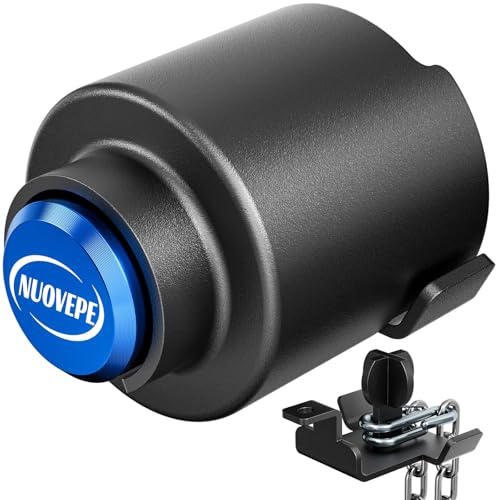
NUOVEPE Trailer Hitch Lock Review Summary
The main reason to buy this lock is straightforward: it tries to protect both the coupler and the safety chains at the same time.
That matters for boat trailers, cargo trailers, dump trailers, and RV use where theft often targets whatever is quickest to cut, pry, or detach.
If your trailer lives outdoors, gets parked at ramps or job sites, or sits for long stretches between uses, this is the kind of hardware that can add meaningful friction for a thief.
Best fit: buyers who want a heavy-duty, all-weather trailer lock with a more enclosed anti-pry design than basic puck-style coupler locks.
Best skip: owners who only need occasional driveway deterrence or who want the lightest possible lock.
Review Scorecard
| Category | Score | Why it scores this way |
|---|---|---|
| Theft deterrence | 9/10 | Enclosed steel housing and chain coverage reduce obvious attack points. |
| Weather resistance | 9/10 | Sealed brass core and powder-coated build are meant for rain, salt, mud, and dust. |
| Ease of use | 8/10 | Push-lock design is quick for repeated use, with no loose pins to manage. |
| Fit confidence | 7/10 | Strong on the stated 2 5/16 inch coupler use case, but fit still depends on matching the compatible styles shown. |
| Everyday practicality | 8/10 | Includes five keys and is built for frequent parking, switching, and outdoor storage. |
| Heavy-duty construction | 9/10 | Heat-treated steel and drill-resistant hardware are positioned for harsh environments. |
| Value for higher-risk trailers | 8/10 | The feature set is focused on real theft-pressure scenarios rather than convenience alone. |
Key Features and Specifications of Trailer Hitch Lock
The product is built around a 2 5/16 inch trailer coupler fit and a dual-defense locking approach.
According to the listing, the inner mechanism slides into the coupler while the safety chains connect to an integrated ball-mount style section, then the unit locks with one push.
That setup is the core differentiator here: it is not just a cap over the coupler, but an attempt to close off more of the trailer’s exposed attachment points.
Key listing facts worth weighing:
- Designed for 2 5/16 inch trailer couplers
- Intended for boat trailers, cargo trailers, dump trailers, travel trailers, equipment trailers, and motorcycle haulers
- Uses heat-treated steel housing for added resistance to prying, hammering, and cutting attempts
- Features a sealed brass lock core with anti-pick grooves, hardened drill-resistant pins, and a protected keyway
- Built with a powder-coated exterior for moisture, salt spray, UV exposure, mud, and grime
- Includes 5 keys
- Uses a push-lock style mechanism for fast daily locking
For buyers, the most important detail is not the marketing language but the lock geometry.
Many trailer locks cover the coupler and still leave chain hardware exposed.
This design is clearly trying to reduce those gaps, which should matter more on trailers stored in public lots, marina parking areas, or construction environments.
The sealed lock core is also relevant.
Trailer hardware spends its life in bad weather, so a lock that is meant to resist dust, road salt, and water intrusion is usually a better long-term choice than a plain indoor-style mechanism.
The listing positions this one as a year-round outdoor lock rather than a fair-weather deterrent.
Pros and Cons of Trailer Hitch Lock
Pros
- Strong anti-theft layout that covers more than the coupler alone
- Weather-oriented construction for salt, rain, snow, mud, and UV exposure
- Fast push-lock operation for frequent trailer use
- Heavy-duty steel build that should create more effort and noise for an attacker
- Five-key bundle is practical for shared use or backups
Cons
- Fit is specific, so buyers should verify the exact compatible coupler style before ordering
- Heavier-duty locks are bulkier and less convenient than simple deterrent locks
- Not every trailer owner needs this much protection, especially for low-risk storage
- The strongest value comes in outdoor/high-theft settings, so casual users may overbuy
The pros line up with the intended use case: outdoor parking, frequent stops, and trailers that cannot be watched constantly.
The cons are mostly the natural tradeoff of stronger hardware.
A more secure lock almost always costs more in weight, size, and setup effort.
Who Should Buy Trailer Hitch Lock?
This lock makes the most sense for owners who leave trailers in places where strangers can reach them easily.
If you park near boat ramps, marinas, landfills, roadside worksites, campgrounds, or storage lots, the combination of a sealed core and enclosed steel body is more relevant than convenience-first design.
It also fits buyers who have already learned that a standard coupler lock is not always enough.
If your concern is not only keeping someone off the hitch, but also making chain tampering harder, this product’s layout is the right kind of escalation.
You should probably skip it if your trailer sits inside a locked garage, if you only need light deterrence for short stops, or if your coupler setup does not match the stated compatibility.
In those cases, a simpler lock may be cheaper, lighter, and easier to live with.
How the Trailer Hitch Lock Fits Real Trailer Use
Outdoor Storage and Overnight Parking
The strongest argument for this lock is the kind of use it was designed around: outdoor parking where weather and theft risk both matter.
The sealed keyway, powder coat, and solid steel construction all point toward trailer owners who cannot treat security hardware as a fair-weather accessory.
Fast Stops and Frequent Hookups
The push-lock style is important for people who connect and disconnect often.
Trailer security that is annoying to use tends to get left off, which defeats the purpose.
A faster locking action is a practical advantage if you are juggling fuel stops, campground arrivals, or repeated worksite moves.
Chain Protection and Anti-Pry Geometry
The distinctive feature here is the attempt to secure the chains along with the coupler.
That matters because exposed chain gaps can be easier to attack than the coupler body itself.
By reducing those open points, the lock may slow common theft methods and create a more awkward target.
Harsh-Environment Durability
The listing repeatedly emphasizes resistance to salt, mud, moisture, dust, and UV exposure.
That is not just filler for marine buyers; it is a sign that the product is meant for trailers that live outside and need more than periodic hand-wringing to stay functional.
Alternatives to Trailer Hitch Lock
If you want a different security style, the most credible alternatives are usually from established trailer-lock brands and mainstream hitch hardware lines.
The right comparison depends on whether you want simpler fit, a different locking format, or a less enclosed design.
- Trimax trailer coupler lock
- Master Lock trailer lock
- BOLT trailer lock
- Proven Industries trailer lock
Trimax and Master Lock are the obvious starting points if you want broad Amazon availability and a familiar coupler-lock format.
BOLT is worth comparing if you care about keyed-to-vehicle style convenience or a different fit philosophy.
Proven Industries is a stronger comparison if your priority is more serious physical security and you are willing to trade simplicity for heavier hardware.
Is Trailer Hitch Lock Worth It?
Yes, if your trailer regularly sits outdoors and you want more than basic deterrence.
The NUOVEPE trailer hitch lock is most compelling for people who need stronger anti-pry protection, better weather resistance, and a design that tries to cover both the coupler and safety chains.
It is less compelling for low-risk storage or casual users who only need a simple lock for short stops.
For the right trailer owner, though, this is a sensible security upgrade because it is built around the realities of outdoor trailer theft rather than generic lock marketing.