The Philips WiFi Keypad Door Lock with Handle is aimed at buyers who want a single front-door upgrade that combines app control, keypad entry, fingerprint unlock, and a matching handle.
If you are comparing a smart lock and a door hardware refresh at the same time, this one is built around that use case.
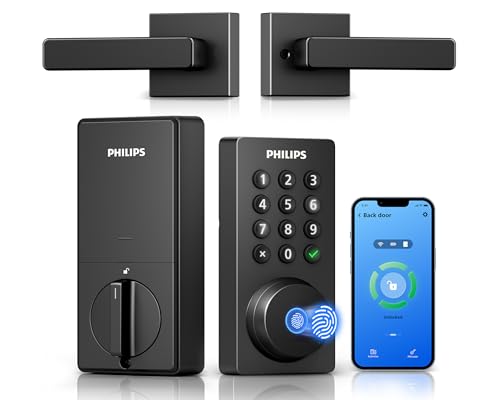
Philips WiFi Keypad Door Lock Review Summary
The Philips WiFi Keypad Door Lock with Handle makes sense for homeowners who want remote access, flexible entry options, and a cleaner all-in-one look without adding a separate hub.
Its biggest appeal is convenience: built-in WiFi, app control, biometric access, and included handle hardware reduce the number of extra parts you need to think about.
It is especially relevant for busy households, short-term rental hosts, and anyone who wants to hand out temporary or recurring codes instead of physical keys.
The listing also points to a strong fit for people who want a lock that can automatically secure the door after a delay, with battery life and low-battery warnings designed to reduce day-to-day hassle.
Review Scorecard
| Category | Score | Rationale |
|---|---|---|
| Smart access flexibility | 9/10 | Supports app control, keypad codes, fingerprints, and voice assistant use. |
| Convenience | 9/10 | Built-in WiFi and auto-lock options reduce routine lockup friction. |
| Installation simplicity | 8/10 | The listing says it installs with a screwdriver and fits common door thicknesses. |
| Security features | 8/10 | Fingerprint access, PIN options, access history, and lock status checks are all useful. |
| Households and hosting | 9/10 | Permanent, one-time, periodic, and recurring PINs suit families and Airbnb-style use. |
| Hardware completeness | 8/10 | The included handle set makes it a more complete front-door package. |
| Battery practicality | 7/10 | Six-month battery life is solid, but batteries are not included and only alkaline is recommended. |
Key Features and Specifications of Philips WiFi Keypad Door Lock
Philips positions this as a built-in WiFi smart lock for a front door, so you do not need a separate hub or bridge.
The listing says it connects on 2.4GHz WiFi and can be managed through the Philips Home Access app for remote lock and unlock control, code management, fingerprint management, lock status checks, and access history.
It also supports Alexa and Google Assistant voice commands for lock status and locking actions.
For entry methods, the lock combines keypad PINs with fingerprint unlocking, and the listing calls out support for permanent, one-time, periodic, and recurring codes.
That mix matters because it is more flexible than a basic keypad deadbolt and more shareable than a biometric lock alone.
Battery life is listed at up to six months, with low-battery alerts to help reduce surprises.
The product uses standard 1.5V alkaline batteries, and the listing specifically warns against rechargeable or high-power lithium batteries.
Auto-lock can be set from 0 to 180 seconds through the app, but it is off by default, so buyers need to enable it intentionally.
The bundle includes a matching handle set, which is a meaningful detail.
Some smart locks solve access but leave the rest of the door hardware mismatched; here, the package is presented as a full front-door lock set.
Philips also says it fits most doors from 1-3/8″ to 1-3/4″ thick and can be installed with a screwdriver.
Pros and Cons of Philips WiFi Keypad Door Lock
Pros
- Built-in WiFi means no hub or bridge is required.
- App control covers remote locking, unlocking, code setup, fingerprints, and history.
- Fingerprint entry adds speed for daily use.
- The keypad supports multiple code types, which is useful for guests and temporary access.
- The included handle set makes the purchase feel more complete.
- Auto-lock settings add a useful safety backstop for forgetful mornings.
Cons
- Auto-lock is off by default, so buyers must remember to turn it on.
- Batteries are not included.
- The battery guidance is specific enough that some buyers may need to check what they already have on hand.
- WiFi dependence means placement near the router matters for the best result.
- Right-opening orientation is the default, so left-opening doors need extra attention during setup.
Who Should Buy Philips WiFi Keypad Door Lock?
This Philips lock is a strong fit for homeowners who want to move away from physical keys without giving up easy local access.
It is especially sensible if you want one device to handle app control, keypad entry, and fingerprint access at the same front door.
It also suits families that need different access methods for different people.
A parent may prefer fingerprint access, while children or guests can use codes.
The recurring and one-time PIN options make it more practical for cleaners, neighbors, contractors, and rental guests than a lock that only supports a fixed code.
Short-term rental hosts should also look closely.
The app-based access management and access history are clearly aligned with that use case.
If you manage a property, being able to issue and rotate codes without handing over keys is the real value here.
You should probably skip it if you do not want to think about WiFi placement, battery replacement, or app setup.
If your door is outside the listed thickness range, if you want a simpler purely mechanical lock, or if you are not interested in biometric and smart features, the added capability may not be worth the extra complexity.
How the Philips WiFi Keypad Door Lock Fits Daily Use
Remote Control and Access Logs
The app control is one of the main reasons to buy this model.
Being able to lock or unlock remotely, check status, and review access history gives you more visibility than a standard keypad deadbolt.
For households with irregular schedules, that can remove a lot of guesswork.
Fingerprint and PIN Entry
Fingerprint unlock is the most immediate convenience feature here because it promises fast access without needing a key or memorized code.
The keypad remains important because it gives you a backup entry method and makes the lock more useful for shared access, guests, and temporary permissions.
Auto-Lock and Battery Planning
Auto-lock from 0 to 180 seconds is a practical feature, but the default-off setting matters.
Buyers who want this behavior need to enable it in the app and choose a delay that matches how they actually leave the house.
Battery planning also matters because the lock depends on standard alkaline batteries, not rechargeable packs.
Alternatives to Philips WiFi Keypad Door Lock
If you want a similar smart deadbolt without the handle bundle, look at the Schlage Encode Smart WiFi Deadbolt.
It is a common alternative for buyers who want WiFi access and keypad entry in a more established deadbolt-only format.
If fingerprint access is your top priority, the Aqara Smart Lock U100 is worth comparing because it is often chosen by buyers who care more about biometric convenience and smart-home integration than about a bundled handle set.
If you want a budget-conscious keypad smart lock, the Yale Assure Lock 2 is a credible line to compare.
It appeals to shoppers who want a recognizable brand and a modular smart-lock path without committing to the exact Philips hardware package.
For buyers who want a similar all-in-one front-door look, the Kwikset Halo Touchscreen WiFi Smart Lock is another practical option.
It is especially relevant if you prefer a mainstream lock brand and want to compare keypad-first designs.
Is Philips WiFi Keypad Door Lock Worth It?
Yes, if you want a smart front-door lock that blends remote control, fingerprint access, keypad codes, and a matching handle into one package.
It is worth considering for busy households and hosts who value flexible entry more than minimalist hardware.
The main tradeoff is complexity: you are buying a connected lock, so WiFi placement, app setup, battery management, and door-fit checks all matter.
If that is acceptable, the feature set is broad enough to justify serious consideration.
If you only want simple key replacement, this is probably more lock than you need.