Installing or replacing door hinges is much easier when the mortise is routed cleanly and consistently. The right hinge jig helps position the hinge, guide your router, and reduce measuring errors across multiple doors.
We compared 10 hinge jigs for door hinges, including compact templates and adjustable aluminum kits for square and rounded-corner hinges. Use the guide below to match features, compatibility, and setup style to your project.
Best 10 Hinge Jigs for Door Hinges Picks for 2026
Simple Template Kit

- Includes 3-inch and 3.5-inch templates
- Bearing-guided router bit included
- Works on doors and jambs
Best For: Standard-size hinge installations
Adjustable Aluminum Pick
AXIUM Adjustable Door Hinge Jig
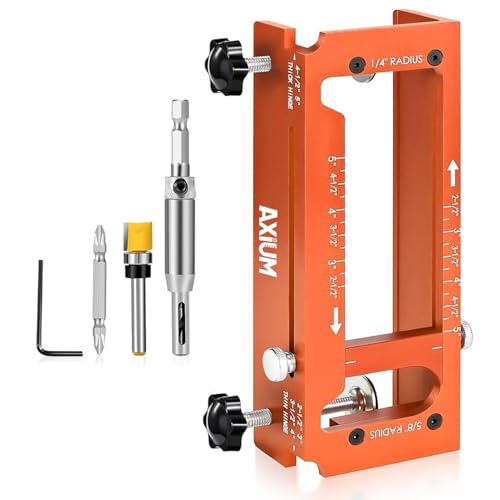
- Fits 2.5- to 5-inch hinges
- CNC-machined aluminum construction
- Includes router and self-centering bits
Best For: Varied hinge sizes on door leaves
Complete Installation System

- Mortises 2.5- to 4.5-inch hinges
- Padded dual clamping design
- Includes latch and strike templates
Best For: Complete standard-door hardware installation
Heavy-Duty Adjustable Option

- Fits 2.5- to 5-inch hinges
- 6061 aluminum alloy construction
- Includes cutter, bits, and chisel
Best For: Varied interior and exterior door hinges
Versatile Door Hardware Jig

- 6061 aluminum construction
- Fits 2-1/2- to 5-inch hinges
- Includes router and drill accessories
Best For: DIY door hinge and latch preparation
Complete Door Prep Kit

- Combines hinge and lock templates
- Fits 2.5- to 5-inch hinges
- Includes drilling and routing accessories
Best For: Door renovation projects with multiple hardware tasks
Precision Routing Choice

- Built-in depth settings
- Fits 2-1/2- to 5-inch hinges
- GripMaxx surface protects door finish
Best For: Repeatable hinge and latch routing
Best Adjustable Plastic Jig

- Fits 3- to 5-inch hinges and three corner styles
- Includes router and self-centering hinge bits
- Non-slip pads support stable, scratch-conscious routing
Best For: DIY and occasional door installation
Best Heavy-Duty Aluminum Jig
Adjustable Mortise Router Template

- CNC-machined 6061 aluminum construction
- Fits 2.5- to 5-inch hinges and multiple corner styles
- Includes three useful installation bits
Best For: Frequent DIY or professional door work
Best for 1-3/4-Inch Doors

- Fits 2.5- to 5-inch hinges
- Designed for 1-3/4-inch-thick doors
- Includes depth guide and three installation bits
Best For: On-site and professional wooden-door projects
Simple Template Kit – Milescraft Hinge Mate 150
For straightforward door hinge installation, the Milescraft Hinge Mate 150 is a compact option among hinge jigs for door hinges. It includes templates for common 3-inch and 3.5-inch hinges and is designed for use on both doors and jambs when the supplied stop is installed.
Best For: DIY users installing standard 3-inch or 3.5-inch hinges on doors or jambs.
Pros:
- Includes 3-inch and 3.5-inch hinge templates.
- Comes with a 1/2-inch bearing-guided straight router bit.
- Works on doors and jambs with the stop installed.
Cons:
- Limited to the included 3-inch and 3.5-inch hinge sizes.
- Its alloy-steel and plastic construction is less substantial than an all-metal jig.
This kit makes sense when your project uses standard hinge sizes and you want the router bit and mounting hardware included. For larger or less typical hinges, an adjustable jig may be more versatile.
Adjustable Aluminum Pick – AXIUM Adjustable Door Hinge Jig
The AXIUM Door Hinge Jig is an adjustable choice among hinge jigs for door hinges, covering hinge lengths from 2.5 to 5 inches. Its CNC-machined aluminum body, built-in depth gauge, and included bits are aimed at repeatable mortising without assembly.
Best For: DIYers and woodworkers who need one jig for varied hinge sizes on door leaves.
Pros:
- All-aluminum construction provides rigidity and resistance to deformation.
- Adjusts for hinge lengths from 2.5 to 5 inches and several hinge thicknesses.
- Includes a router bit, self-centering hinge bit, screwdriver bit, and hex key.
- Non-slip pads help stabilize the jig and protect the door surface.
Cons:
- Not intended for use on door frames.
- Square-corner mortises require the appropriate cutting approach, while the jig supports listed radius options.
Choose the AXIUM when adjustability and a metal body matter more than a basic fixed template. Its one-piece design keeps setup simple, though frame work is outside its stated application.
Complete Installation System – Milescraft HingeJigPLUS
The Milescraft HingeJigPLUS is a broad-use option among hinge jigs for door hinges, routing mortises for hinges from 2.5 to 4.5 inches. Its padded dual-clamping design, adjustable settings, and included latch and strike templates make it suited to complete standard-door installation work.
Best For: Installers handling standard 1-3/8-inch or 1-3/4-inch doors who want hinge, latch, and strike templates in one kit.
Pros:
- Built-in padded clamps reduce the need for mounting screws or nails.
- Adjusts for standard 1-3/8-inch and 1-3/4-inch door thicknesses.
- Supports 2.5- to 4.5-inch hinges and multiple corner profiles.
- Includes latch and strike plate templates for a more complete installation.
Cons:
- Square-corner mortises require a chisel.
- Its supported hinge range does not extend to 5-inch hinges.
- The listing notes that the Pin Doctor accessory is no longer included.
This is the strongest fit for projects involving more than just hinge mortises. The integrated clamps and door-hardware templates add convenience, especially when installing a complete set of standard door hardware.
Heavy-Duty Adjustable Option – Aluminum Alloy Door Hinge Jig
This aluminum alloy jig is a versatile entry among hinge jigs for door hinges, supporting hinge lengths from 2.5 to 5 inches and square or listed radius corners. Its multi-stage depth adjustment, anti-slip pads, and included cutting accessories are designed to simplify door-leaf mortising.
Best For: DIYers and professionals working with varied interior or exterior door hinges from 2.5 to 5 inches.
Pros:
- 6061 aluminum alloy construction with anodized surface treatment.
- Accommodates 2.5- to 5-inch hinges and 1/4-inch or 5/8-inch radius corners.
- Includes router cutter, self-centering drill bit, screwdriver bit, and chisel.
- Rubber anti-slip pads help prevent shifting and surface damage.
Cons:
- Designed for door leaves and not door frames.
- Square-corner work requires use of the included chisel.
- Its broad adjustability may be unnecessary for a single standard-size hinge project.
Consider this jig when you want a metal adjustable template with a wide hinge-size range and a more complete accessory package. For frame mortising, you will need a tool specifically designed for that application.
Versatile Door Hardware Jig – Hinge and Latch Router Kit
If you need hinge jigs for door hinges plus a way to route latch plates, this combined aluminum kit covers both jobs. Its adjustable hinge template handles 2-1/2- to 5-inch hinges, while the included accessories support router- and drill-based installation work.
Best For: DIYers and woodworkers preparing door hinges and latch plates on doors up to 1-3/4 inches thick.
Pros:
- 6061 aluminum construction with an anodized coating resists deformation.
- Supports 2-1/2- to 5-inch hinges and 1-3/8- or 1-3/4-inch doors.
- Includes a router bit, self-centering bit, and double-ended driver bit.
- Built-in depth gauges help set cuts for different hinge and latch requirements.
Cons:
- The hinge jig is intended for doors, not jambs or frames.
- Square-corner hinges require additional chiseling after routing.
- The latch template is for door latch plates, not strike plates.
This is a practical all-in-one option when you want one setup for hinge mortises and door latch plates. Check the door and hardware limitations before buying, especially if you need jamb or strike-plate work.
Complete Door Prep Kit – Aluminum Hinge and Lock Jig
Among hinge jigs for door hinges, this kit stands out by combining hinge mortising with lock-hole preparation. The aluminum hinge template includes a depth gauge and non-slip pads, while the separate lock template is sized for common door thicknesses and latch backsets.
Best For: DIY renovations and small carpentry jobs requiring both hinge mortises and knob or deadbolt hole positioning.
Pros:
- Combines an aluminum hinge jig with a lock installation template.
- Handles 2.5- to 5-inch thin and thick hinges.
- Non-slip silicone pads help stabilize the jig and protect door surfaces.
- Includes router, drilling, hole-saw, arbor, and screwdriver accessories.
Cons:
- The lock installation template is plastic rather than aluminum.
- It is not intended for work on door jambs.
- Square hinges may need simple chisel trimming after routing.
This is a strong choice if your project includes more than hinge mortising. Its broad hinge range and included lock-drilling components can reduce separate measuring and tool purchases, provided the included templates match your door hardware.
Precision Routing Choice – Kreg Door Hinge Mortise Jig
For shoppers comparing hinge jigs for door hinges, the Kreg Door Hinge Routing Jig focuses on repeatable mortising and latch routing. Built-in depth settings, a one-piece adjustable guide stop, and a GripMaxx clamp surface simplify setup for 2-1/2- to 5-inch hinges.
Best For: Woodworkers who want a purpose-focused jig for consistent hinge and latch routing on 1-3/8- or 1-3/4-inch doors.
Pros:
- Built-in depth settings support consistent mortise cuts.
- Adjustable guide stop accommodates 2-1/2- to 5-inch hinges.
- GripMaxx clamping helps hold the jig without damaging door surfaces.
- Carbide-tipped router bit is specified for smooth, precise cuts.
Cons:
- The listed compatible router bit is the Kreg 1/2-inch flush-trim bit with a 1/4-inch shank.
- The supplied notes do not indicate that the jig includes a broad accessory bundle.
This Kreg model is best suited to buyers prioritizing controlled setup and repeatable routing over an all-in-one hardware kit. Confirm that you have the specified router bit before starting the project.
Best Adjustable Plastic Jig – Compact Door Hinge Mortiser
If you need hinge jigs for door hinges in several common sizes, this adjustable template covers 3- to 5-inch hinges and multiple corner styles. Its reference marks, depth gauge, and included bits are aimed at faster, more repeatable mortising with a compact or trim router.
Best For: DIY door installation, replacement doors, renovation, and woodworking projects where a lighter plastic jig is suitable.
Pros:
- Fits 3″, 3-1/2″, 4″, 4-1/2″, and 5″ hinges.
- Supports square, 1/4-inch radius, and 5/8-inch radius hinge types.
- Includes a router bit, self-centering hinge bit, and double-ended screwdriver bit.
- Non-slip pads help stabilize the jig and protect the door surface.
Cons:
- Designed for door mortises only, not jambs or frames.
- Requires a compatible compact or trim router, which is not included.
- Plastic construction may be less suitable for demanding frequent-use work than an aluminum jig.
This is a versatile, value-oriented option for occasional door work. Secure it firmly, verify router compatibility and bit engagement, and use multiple shallow passes for cleaner results.
Best Heavy-Duty Aluminum Jig – Adjustable Mortise Router Template
For buyers comparing hinge jigs for door hinges by durability, this CNC-machined 6061 aluminum model is built for repeated use. Its adjustable design covers 2.5- to 5-inch hinges, while the integrated depth gauge helps streamline setup.
Best For: DIY users and professional carpenters who want a durable, reusable jig for interior and exterior wooden doors.
Pros:
- 6061 aluminum construction resists deformation better than plastic alternatives.
- Handles thin 2.5- to 4-inch and thick 4.5- to 5-inch hinges.
- Works with 1/4-inch radius, 5/8-inch radius, and square-corner hinges.
- Includes router, self-centering hinge, and double-ended driver bits.
Cons:
- For doors only; it is not intended for door jambs or frames.
- Square-corner hinge work requires a chisel.
- The router needed for mortising is not included.
The aluminum build makes this a strong choice when durability and repeatable setup matter. Anti-slip pads add stability, but the jig should still be secured carefully before routing.
Best for 1-3/4-Inch Doors – Red Aluminum Hinge Jig
This red aluminum template is a practical pick among hinge jigs for door hinges when you need broad size coverage for standard 1-3/4-inch-thick doors. It supports 2.5- to 5-inch hinges, multiple corner profiles, and includes the basic bits for installation.
Best For: On-site construction, carpentry, handyman work, and homeowners installing hinges on indoor or outdoor wooden doors.
Pros:
- Fits 2-1/2- to 5-inch hinges on 1-3/4-inch-thick doors.
- Supports 1/4-inch radius, 5/8-inch radius, and square-corner hinges.
- Machined 6061 aluminum and an anodized surface provide a durable platform.
- Includes router, self-centering hinge, and double-ended screwdriver bits.
Cons:
- Limited to door mortising rather than jamb or frame work.
- Hinges are not included.
- Its stated door-thickness fit is specifically 1-3/4 inches.
Choose this model if its door-thickness specification matches your project and you value aluminum durability. The depth guide and anti-slip clamping pads should make repeated hinge placement more consistent.
How We Picked These Hinge Jigs for Door Hinges
We focused on the features that matter during real door installation: hinge-size range, adjustment options, template stability, router compatibility, corner-radius support, and included accessories. Products were also considered for the types of projects they suit, from installing a single replacement hinge to routing mortises on new doors in a workshop.
Because product listings and included components can vary, verify the current specifications before buying. In particular, check whether the kit includes a router bit, clamps, latch templates, or only the jig itself.
Quick Comparison
| Best For | Look For |
|---|---|
| Occasional repairs | Simple setup and a compact template |
| Multiple hinge sizes | Adjustable stops covering roughly 2.5 to 5 inches |
| Professional or repeat work | Dual clamping, rigid construction, and precise adjustments |
| Mixed hinge profiles | Support for square and common radius corners |
| Complete door hardware installation | A kit that also includes a latch or lock template |
Key Buying Factors
Hinge Size and Adjustability
Measure the hinge leaf before choosing a jig. Fixed templates may be convenient for common 3- or 3.5-inch hinges, while adjustable models are more flexible for 2.5- to 5-inch hardware. Confirm that the adjustment scale is clear and locks securely.
Corner Shape Compatibility
Square-corner hinges require a different mortise finish than rounded hinges. If your hardware has radius corners, choose a jig that supports the correct radius, such as 1/4-inch or 5/8-inch, or plan to finish the corners with a chisel.
Clamping and Stability
A template that shifts can ruin the mortise and damage the door. Look for strong clamps, broad contact surfaces, and a rigid aluminum or reinforced frame. Dual-clamping designs can be especially useful on heavy doors or during repeated routing.
Router and Bit Requirements
Check the jig’s required router type, guide-bushing dimensions, and maximum bit size. Some kits include the necessary bit or accessories; others require you to supply them. Always confirm that your router can fit the template before starting.
Build Quality and Storage
Metal templates generally resist wear and hold their shape better than thin plastic guides. Adjustable parts should move smoothly but lock firmly. A kit with labeled components or a storage case can also save setup time.
Who Should Buy Which Hinge Jigs for Door Hinges?
Choose a straightforward fixed-size jig if you are replacing common residential hinges and want the simplest setup. An adjustable model is the better all-around choice for homeowners, remodelers, and DIYers working with doors of different ages or manufacturers. For frequent installations, prioritize a rigid, dual-clamp design with repeatable stops. If you are installing a complete lockset as well as hinges, a combined hinge-and-latch kit may offer better value and fewer separate tools.
Before routing, test the setup on scrap material, confirm the hinge orientation, and make several shallow passes rather than forcing the router through the full depth at once.