Managing keys across multiple properties can quickly become a security and accountability problem. The best key cabinets for property managers keep access organized while making it clear who has each key and when it was removed.
This roundup compares cabinets ranging from compact combination-lock boxes to large-capacity systems with digital codes, apps, deposit slots, and dual-lock controls, so you can match storage to your portfolio and workflow.
Best 10 Key Cabinets for Property Managers Picks for 2026
Best for Tracked Key Circulation

- App tracks key borrowing and returns
- Steel wall-mounted cabinet with color tags
- Compact design for shared key storage
Best For: Property teams needing key-access accountability
Best for Code-Based Access
Uniclife 60-Position Key Cabinet

- 60 hooks with adjustable numbered racks
- Resettable four-digit combination lock
- Includes color tags and backup keys
Best For: Smaller property teams using shared access codes
Best for Large Portfolios

- Stores up to 150 labeled keys
- Heavy-gauge powder-coated steel construction
- Includes two keys and mounting hardware
Best For: Large properties with extensive key inventories
Best for Dual-Lock Control

- 110 numbered hooks for organized storage
- Welded 22-gauge steel construction
- Includes write-on tags and mounting hardware
Best For: Busy property offices needing physical lock control
Best High-Capacity Pick

- 60 numbered positions with colored tags
- Programmable keypad plus backup keys
- Welded-steel wall-mount construction
Best For: Property managers needing high-capacity digital key storage
Best Smart-Access Pick

- Fixed, temporary, and one-time codes
- App tracks key borrowing and returns
- Optional gateway supports remote unlocking
Best For: Property teams needing permission controls and activity tracking
Best Mechanical-Lock Pick
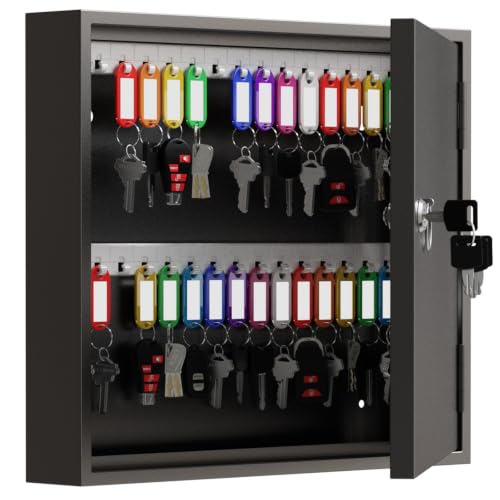
- 60-key capacity with numbered organization
- Mechanical lock needs no batteries
- Recessed door and magnetic closure
Best For: Property managers preferring simple mechanical access
Best Compact Pick
Uniclife 20-Key Combination-Lock Cabinet

- 20 numbered key positions
- Resettable 3-digit combination lock
- Color-coded tags and mounting hardware included
Best For: Small indoor key collections
Best Heavy-Duty Pick
BankSupplies STEELMASTER 200-Key Cabinet

- Stores up to 200 keys
- Steel body with powder-coated finish
- Numbered and out-key tags included
Best For: Large teams and extensive key inventories
Best Mid-Size Pick
KYODOLED 40-Key Wall-Mount Cabinet

- 40 compartments for keys and many fobs
- Keyed lock with two keys included
- Writable color-coded identification tags
Best For: Mid-size rental and office key collections
Best for Tracked Key Circulation – WeHere 120-Key Smart Cabinet
For property managers who need more than basic storage, this WeHere cabinet adds app-based borrowing and return tracking to a wall-mounted key organizer. Its steel construction, color tags, and stated 120-key size make it a practical option for shared residential, office, or school keys.
Best For: Property managers who need accountability for key access and returns.
Pros:
- App tracking records access-code creation, borrowers, and returns.
- Includes multicolor tags for organizing keys by location or user.
- Wall-mounted steel cabinet includes mounting screws and anchors.
- Compact 2.3-inch depth helps conserve wall space.
Cons:
- App-based tracking may require additional setup and user coordination.
- The supplied notes describe both a 120-key size and 60-key storage capacity, so verify the intended capacity before ordering.
This is the strongest fit when a property team needs a record of who borrowed each key, not simply a locked place to hang them. Confirm the capacity details if your portfolio requires the full stated 120 positions.
Best for Code-Based Access – Uniclife 60-Position Key Cabinet
This Uniclife cabinet suits property managers who want organized storage with combination-lock access. It provides 60 numbered hooks, adjustable racks, writable tags, and a backup key option in a steel wall-mounted enclosure.
Best For: Smaller property portfolios and offices that prefer a resettable combination lock.
Pros:
- 60 hooks provide dedicated positions for a sizable key collection.
- Four-digit lock offers 10,000 possible combinations and includes two spare keys.
- Six adjustable racks and numbered stickers support quick identification.
- Includes 60 tags in five colors, a log sheet, marking pen, and mounting hardware.
Cons:
- Its 60-key capacity is lower than larger cabinets in this roundup.
- The cabinet is 5.5 inches deep, requiring more wall clearance.
Choose this model when a shared code is more convenient than issuing a cabinet key to every authorized user. Its labeling and rack system should also help staff find keys without sorting through an unstructured box.
Best for Large Portfolios – 150-Key Wall-Mount Cabinet
When a property manager needs to consolidate a large number of unit, vehicle, or maintenance keys, this 150-position cabinet offers substantial capacity in a wall-mounted steel enclosure. Color labels, numbered hooks, two emergency keys, and included mounting hardware support a straightforward key-control setup.
Best For: Large property portfolios, dealerships, hotels, and other operations managing many keys.
Pros:
- 150 key positions accommodate larger collections than the other listed cabinets.
- Includes 150 colorful labels for categorizing and identifying keys.
- Powder-coated, scratch-resistant steel is designed for regular use.
- Includes two lock-box keys and four screw kits for wall installation.
Cons:
- The cabinet is 19.69 inches high and weighs 13.7 pounds, so installation requires an appropriate wall location.
- Access uses physical keys rather than a combination or app-based system.
- The notes list two doors, which may require more clearance when opened.
This is the capacity-focused choice for managers who would otherwise need multiple smaller boxes. It is especially practical when a simple keyed lock and extensive color labeling meet your access-control requirements.
Best for Dual-Lock Control – STEELMASTER 110-Key Cabinet
This STEELMASTER cabinet is designed for busy offices and property operations that need 110 clearly numbered key positions and dual-lock control. Its welded 22-gauge steel body, hinged door, write-on tags, and included mounting hardware provide a conventional, organized approach to key storage.
Best For: Property managers who want a durable, numbered cabinet with dual-lock access control.
Pros:
- Stores up to 110 keys on numbered hooks.
- Welded 22-gauge steel construction has a scratch-resistant powder-coated finish.
- Includes numbered tags 1–110 plus 11 “out key” yellow tags.
- Piano-hinged door opens wide while unlocked and is intended to help avoid forced entry.
Cons:
- The listed installation details are mixed: it is described as freestanding while also supporting wall mounting.
- Its keyed dual-lock setup may be less convenient than a combination lock for larger staff groups.
- Tags are write-on rather than app-connected or color-coded by default.
For teams that prefer a traditional numbered cabinet and physical control over access, the STEELMASTER offers a solid middle-capacity option. Verify the mounting arrangement and dual-lock procedure before installation.
Best High-Capacity Pick – 60-Key Digital Key Cabinet
For property managers comparing key cabinets for property managers, this 60-position UMEKEN cabinet offers a straightforward way to organize apartment, office, or facility keys. Its programmable keypad, numbered tags, wall-mount format, and backup keys support frequent daily access without requiring the main cabinet key.
Best For: Property managers and offices that need high-capacity, wall-mounted key storage with digital access.
Pros:
- Stores up to 60 keys using included colored tags.
- Programmable battery-powered keypad avoids routine key-based entry.
- Includes two backup keys, four AA batteries, and mounting hardware.
- Welded-steel, powder-coated construction is designed for durable use.
Cons:
- Requires batteries for normal keypad operation.
- It is not water resistant.
- The cabinet is relatively deep and heavy at about 17 pounds, so mounting needs care.
This is a practical choice when capacity and simple code-based access matter most. Its included accessories make setup easier, while the backup keys provide an alternative during a power-related issue.
Best Smart-Access Pick – 48-Key App-Enabled Cabinet
Among key cabinets for property managers, this 48-key smart cabinet stands out for flexible access control. It supports fixed, time-limited, and one-time codes, Bluetooth app unlocking, and optional Wi-Fi gateway access, making it suitable for coordinating tenants, contractors, employees, or facility staff.
Best For: Property managers and facility teams that need permission-based access and key activity tracking.
Pros:
- Supports multiple unlocking methods, including Bluetooth and one-time codes.
- The WeHere app tracks code creation, key borrowing, and returns.
- Optional Wi-Fi gateway enables remote unlocking and temporary passcode sharing.
- Wall-mounted carbon-steel cabinet provides 48 numbered key positions.
Cons:
- The Wi-Fi gateway is sold separately.
- Some access features depend on app or electronic operation.
- Its 48-key capacity is lower than the 60-key alternatives in this roundup.
This cabinet is the strongest fit when accountability and flexible access permissions are more important than maximum capacity. Buyers should factor in the separate gateway if remote control is required.
Best Mechanical-Lock Pick – 60-Key Steel Key Cabinet
For property managers seeking key cabinets for property managers without battery-dependent access, this 60-key wall-mounted cabinet uses a mechanical key lock and pull-ring handle. Its recessed door, magnetic closure, numbered tags, and cold-rolled steel construction are suited to organized daily key storage in offices and property operations.
Best For: Property managers who prefer a mechanical lock and need 60-key capacity with a security-focused door design.
Pros:
- Holds up to 60 keys and supports tracking by number or name.
- Mechanical lock requires no batteries.
- Recessed door design minimizes exposed gaps for improved pry resistance.
- Magnetic closure and rust-resistant cold-rolled steel support frequent use.
Cons:
- Access depends on the physical cabinet key.
- The listed app-management feature may add complexity compared with a purely mechanical setup.
- At about 15.1 inches wide, it needs a suitable wall location.
This model favors simple, dependable cabinet access while adding design details intended to discourage tampering. It is a sensible option for teams that do not want to manage cabinet batteries but still need substantial organized storage.
Best Compact Pick – Uniclife 20-Key Combination-Lock Cabinet
For property managers handling a smaller key inventory, the Uniclife 20-Key Steel Key Cabinet offers a compact wall-mounted way to organize and control access. Its resettable three-digit combination lock avoids the need to manage a separate cabinet key, while numbered hooks and color-coded tags support quick identification.
Best For: Small offices, schools, homes, and property managers with up to 20 labeled keys.
Pros:
- Stores up to 20 keys in a space-efficient wall-mounted cabinet.
- Resettable three-digit combination lock provides 1,000 possible combinations.
- Includes numbered stickers, hooks, and four-color tags with writable inserts.
- Screws and wall anchors are included for installation.
Cons:
- Recommended for indoor use only.
- Its 20-key capacity may be limiting for larger property portfolios.
- Combination access may be less convenient than a keyed lock for some teams.
This is a practical choice when you need straightforward indoor key control without adding another physical key to your access process. Choose a larger cabinet if your properties require more than 20 positions.
Best Heavy-Duty Pick – BankSupplies STEELMASTER 200-Key Cabinet
For property managers overseeing many units, staff members, or shared assets, the BankSupplies STEELMASTER provides 200 key slots in a wall-mounted steel cabinet. Its standard keyed lock, numbered write-on tags, and separate yellow “out key” tags are designed to support a more structured checkout and tracking routine.
Best For: Large property-management offices, businesses, and organizations managing up to 200 keys.
Pros:
- Provides substantial storage with 200 labeled key slots.
- 22-gauge steel construction has a scratch-resistant powder-coated finish.
- Includes numbered write-on tags from 1 to 200 and yellow “out key” tags.
- Piano-hinged door opens wide and uses a standard keyed lock.
Cons:
- Its large footprint and 11.5-pound weight require a suitable mounting location.
- Uses a keyed lock, so authorized users need access to the cabinet key.
- The high capacity may be excessive for small property portfolios.
This cabinet is the strongest fit when capacity and durable organization matter more than a compact footprint. The numbered and out-key tags are especially useful for teams that regularly issue and retrieve keys.
Best Mid-Size Pick – KYODOLED 40-Key Wall-Mount Cabinet
The KYODOLED 40-Key Cabinet is a balanced option for property managers who need more room than a compact 20-key box but do not need a 200-key cabinet. It combines a keyed steel enclosure with writable, color-coded tags and enough depth for standard keys and many car key fobs.
Best For: Rental properties, offices, service teams, and property managers organizing up to 40 keys or key fobs.
Pros:
- Offers 40 compartments for house, office, rental, vehicle, or fob storage.
- Includes two cabinet keys for daily access and a spare.
- Color-coded writable tags help identify units, rooms, vehicles, or users.
- Wall-mounted steel design saves desk, counter, and drawer space.
Cons:
- Actual capacity can vary with key and key-fob size or thickness.
- Uses a keyed lock rather than a combination lock.
- Its listed maximum weight capacity is 4 pounds.
With 40 positions and room for many car key fobs, this cabinet suits mid-size operations that want a dedicated, organized key station. It is a sensible middle ground between small residential boxes and high-capacity commercial cabinets.
How We Picked the Best Key Cabinets for Property Managers
We focused on the features that matter in rental offices, maintenance departments, leasing operations, and multi-property management: storage capacity, lock design, key identification, mounting practicality, construction, and access accountability. The selection includes compact cabinets for smaller offices, high-capacity units for larger portfolios, and connected or code-based options for teams that need faster handoffs.
Capacity claims are only part of the decision. A cabinet should also make keys easy to label, retrieve, and return without creating bottlenecks. We gave particular attention to included tags, wall-mount formats, write-on surfaces, anti-theft features, and whether the access system suits staff who need frequent entry.
Quick Comparison
| Best For | Recommended Capacity | Useful Features |
|---|---|---|
| Small property teams | 20–40 keys | Combination or keyed lock, compact wall mount |
| Growing portfolios | 48–60 keys | Digital keypad, app access, numbered tags |
| Large operations | 110–200 keys | High-density storage, durable steel, write-on tags |
| Controlled key returns | 60–150 keys | Deposit slot or dual-lock access |
Key Buying Factors for Key Cabinets for Property Managers
Capacity and Future Growth
Count active property, unit, master, maintenance, and vendor keys, then leave room for expansion. A cabinet filled to capacity becomes difficult to organize, so choosing the next practical size can be more efficient than replacing a smaller box later.
Lock and Access Control
Keyed locks are simple and dependable, while combination locks reduce the need to distribute physical cabinet keys. Digital keypad and app-enabled models can make staff access easier to change or monitor. For sensitive master keys, consider stronger controls such as dual-lock designs or controlled-return slots.
Organization and Accountability
Numbered or write-on tags help staff identify keys quickly. If tracking who borrows and returns a key is important, prioritize a system with app logging or establish a sign-out process alongside the cabinet. Clear labels and consistent naming often prevent more errors than capacity alone.
Construction and Installation
Steel construction is a sensible baseline for commercial use. Check the cabinet’s dimensions, mounting hardware, wall strength, door clearance, and installation location before buying. Place it near authorized staff without exposing it to public or visitor traffic.
Who Should Buy Which Key Cabinets for Property Managers?
Choose a 20- or 40-key cabinet for a small office, limited rental inventory, or secondary location. A 48- or 60-key model is a practical middle ground for growing teams, especially when keypad, combination, or app access improves daily handoffs. For larger portfolios, 110- to 200-key cabinets provide more room and reduce the need to split keys across multiple boxes.
Property managers handling frequent contractor access should favor traceability and controlled returns. Teams that mainly need secure, orderly storage may save money with a straightforward keyed or combination cabinet. Before ordering, verify capacity, lock credentials, included tags, mounting requirements, and whether the cabinet’s workflow matches your staff’s actual key-checkout habits.